
XIAMEN ACEY NEW ENERGY TECHNOLOGY CO., LTD.

원통형 배터리 팩 조립 방법: 공정 및 장비 가이드
August 28 , 2026원통형 배터리 팩 조립 방법: 공정 및 장비 안내
전동 공구, 전기 자전거, 드론, 휴대용 발전소 및 에너지 저장 시스템에 사용되는 원통형 배터리 팩은 전압, 용량 및 팩 구조가 매우 다양할 수 있지만 대부분의 생산 라인은 유사한 조립 순서를 따릅니다.
주요 단계에는 셀 용량 등급 분류, 절연지 부착, 개방 회로 전압(OCV) 및 내부 저항 분류, 셀 배열, 극성 검사, 스폿 용접, BMS 테스트가 포함됩니다.그리고설치완제품 포장 테스트, 포장, 코딩 및 충방전 노화 테스트.
이러한 공정은 오프라인 작업대, 반자동 라인 또는 완전 자동 생산 라인으로 구성할 수 있습니다.
원통형 배터리 팩 조립 공정
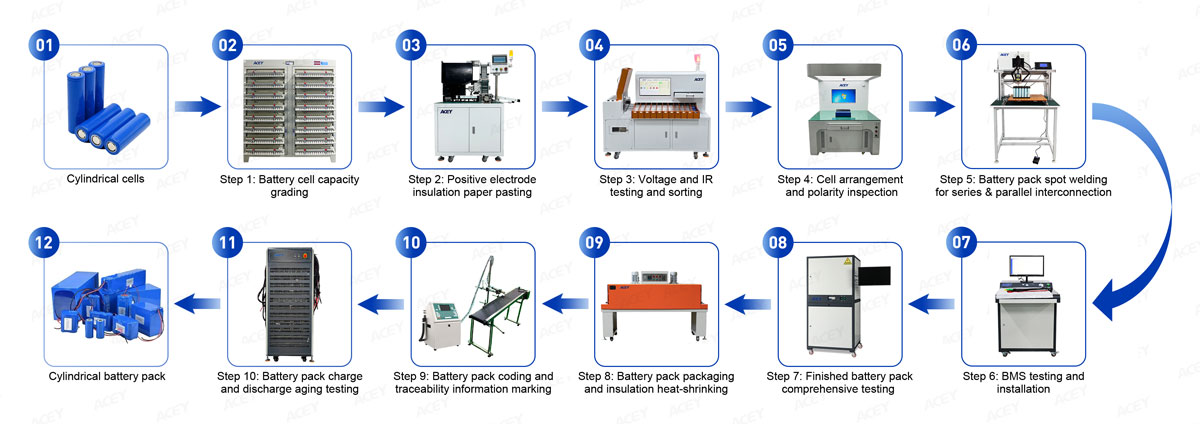
셀 용량 등급 분류 → 절연지 부착 → 개방회로 전압(OCV) 및 교류 전류(ACIR) 분류 → 셀 배열 → 극성 검사 → 스폿 용접 → 배터리 관리 시스템(BMS) 테스트 및 설치 → 배터리 팩 테스트 → 포장 및 코딩 → 충방전 노화 테스트
초기 단계에서는 셀의 일관성과 올바른 배열에 중점을 둡니다. 용접 및 BMS 조립을 통해 팩의 전기적 연결이 이루어지며, 완성된 팩 테스트 및 에이징을 통해 출하 전에 조립된 배터리를 검증합니다.
원통형 배터리 팩의 주요 구성 요소
원통형 배터리 팩은 주로 다음과 같은 구성 요소로 이루어져 있습니다.
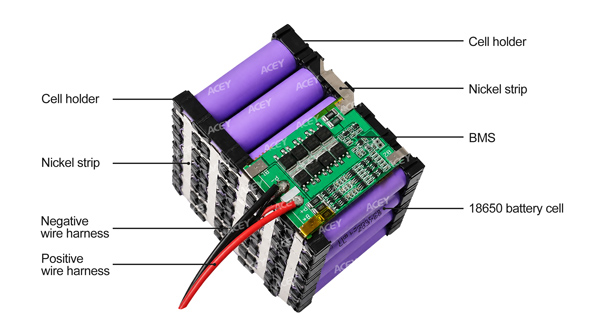
직렬 연결은 팩 전압을 결정하고, 병렬 연결은 용량과 전류 용량을 증가시킵니다.
일반적인 원통형 셀 크기 및 응용 분야
지원되는 셀 형식
14500 · 18650 · 21700 · 26650 · 32650 · 32700 · 32140 · 33140
모든 기계가 동일한 툴링을 사용하는 것은 아닙니다. 세포 직경, 높이 또는 패킹 구조가 변경될 경우 고정 장치, 세포 홀더 및 공급 메커니즘을 변경해야 할 수 있습니다.
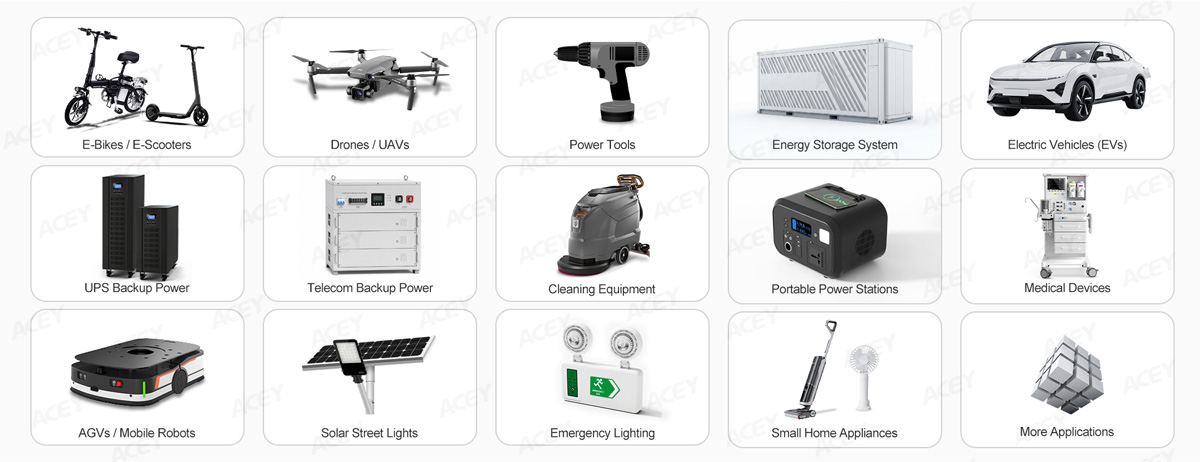
일반적인 적용 사례
원통형 배터리 팩을 조립하는 데 사용되는 장비는 무엇입니까?
완전한 생산 설비에는 다음과 같은 장비가 포함될 수 있습니다.
| 프로세스 | 목적 | 장비 |
| 용량 등급 | 용량별로 세포를 측정하고 그룹화합니다. | 배터리 셀 등급 분류기 |
| 격리 | 양극 단자에 절연지를 대십시오. | 절연지 접착기 |
| OCV 및 ACIR 분류 | 전압과 저항에 따라 전지를 그룹화하세요. | 배터리 분류기 |
| 극성 검사 | 확인하다 팩의 양극 및 음극 단자 | CCD 극성 테스트기 |
| 전기 연결 | 셀에 연결 스트립을 용접합니다. | 배터리 팩 스폿 용접기 |
| BMS 검증 | 테스트 보호 회로 기판 기능 | BMS 테스터 |
| 완제품 포장 테스트 | 조립된 팩의 성능을 검증하십시오. | 배터리 종합 테스터 |
| 포장 | 열수축 필름을 부착합니다. | 열수축기 |
| 신분증 | 인쇄 배치 및 제품 정보 | 코딩 머신 |
| 노화 | 충방전 사이클을 실행하세요 | 배터리 팩 노화 테스트기 |
시제품이나 소량 생산의 경우 여러 공정을 수동으로 진행할 수 있습니다. 대규모 생산 라인에서는 일관성과 생산량에 가장 큰 영향을 미치는 공정, 특히 분류, 극성 검사, 용접 및 테스트 공정을 자동화합니다.
1단계 — 셀 용량 등급 분류
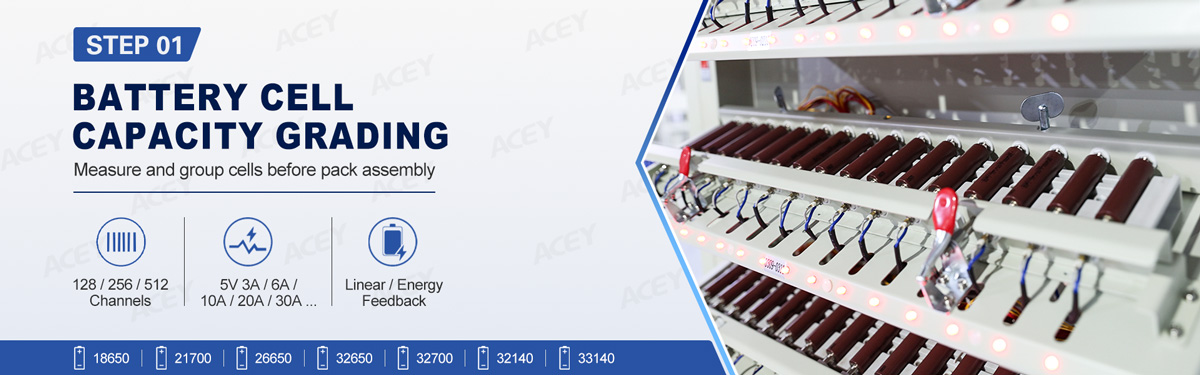
조립 전에 전지를 충전 및 방전하여 사용 가능 용량과 기본 성능을 측정합니다.
이러한 조치의 목적은 장기간 보관 또는 운송 중 전하 소모나 손실로 인해 용량 차이가 크게 나는 셀들이 동일한 배터리 팩에 함께 묶이는 것을 방지하는 것입니다. 용량이 약한 셀은 전체 직렬 또는 병렬 조립체의 사용 가능한 성능을 저하시킵니다.
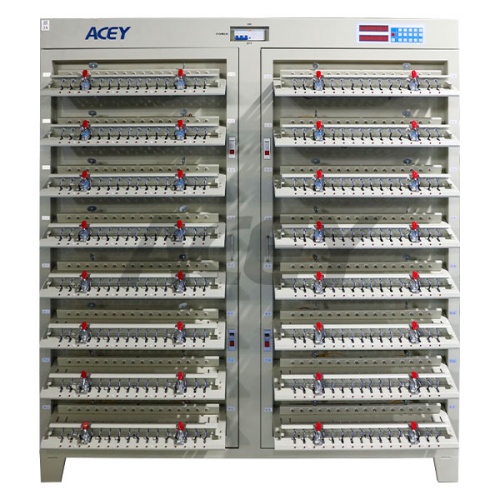
에이 엘이티움이온 세포 분류기 이 시스템은 여러 채널에 걸쳐 프로그래밍된 충방전 사이클을 실행하고 각 셀의 데이터를 기록합니다.
ACEY 등급 분류 시스템은 다음과 같은 일반적인 원통형 형식에 맞게 구성할 수 있습니다.
18650 · 21700 · 26650 · 32650 · 32700 · 32140 · 33140
사용 가능한 구성은 다음과 같습니다.
대량 세포 처리의 경우, 다중 채널 등급 분류를 통해 수백 개의 세포를 동시에 테스트한 후 포장 조립 단계에 들어갈 수 있습니다.
권장 장비: 배터리 셀 등급 분류기
2단계 — 절연지 부착
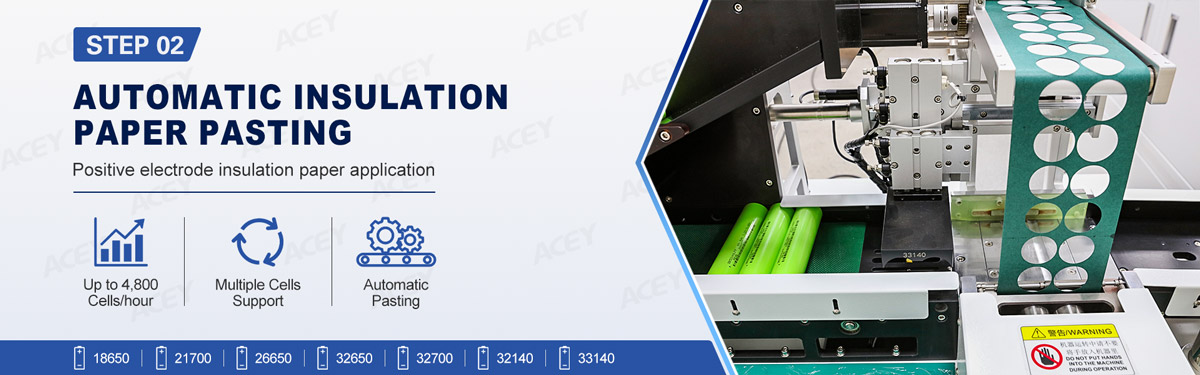
용량 등급 조정 후 양극 단자 주위에 절연지를 감습니다.
이 추가 절연재는 조립 과정에서 양극 단자 영역과 금속 전지 케이스(양극)를 분리하는 데 도움이 됩니다.
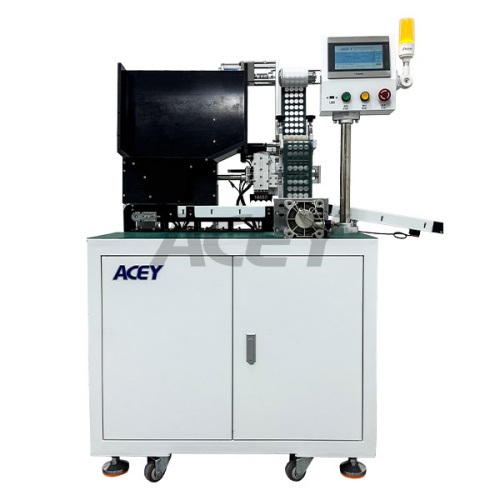
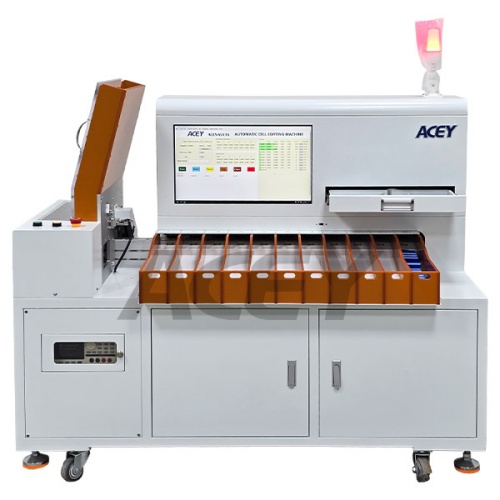
안자동 절연지 접착기ACEY 기계는 일정한 위치로 용지를 절단하고 부착합니다. 다양한 원통형 셀에 맞게 교체 가능한 툴링을 장착할 수 있습니다.
생산 속도는 셀 및 장비 구성에 따라 시간당 최대 4,800개 셀에 달할 수 있습니다.
일반적인 형식은 다음과 같습니다.
18650 · 21700 · 26650 · 32650 · 32700
Larger cylindrical cells such as 32140 and 33140 require suitable tooling and machine configuration.
Recommended Equipment: Battery Insulation Paper Sticking Machine
Step 3 — OCV and Internal Resistance Sorting
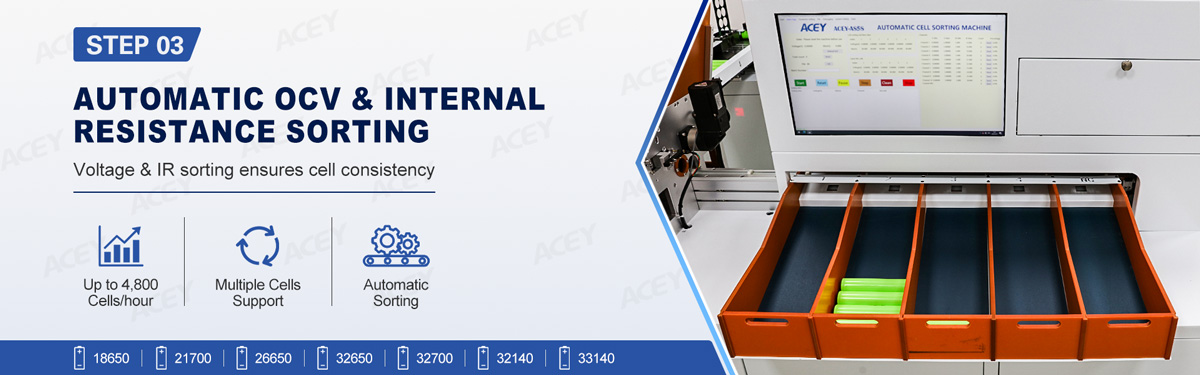
Capacity grading alone is not enough for final cell matching.
Before assembly, it is also necessary to measure theopen-circuit voltageandAC internal resistanceof the battery cells to ensure the consistency of the battery pack.
The measured values are compared with preset ranges, and the cells are automatically separated into different groups.
ACEY cylindrical battery sorting machines are available with standard 5-, 6-, 10-, or 11-channel configurations, with customized options also available. They can be integrated with branded testers such as the HIOKI BT3561 or other compatible instruments to measure open-circuit voltage (OCV) and AC internal resistance.
Barcode scanning can also be added when the production process requires cell-level traceability.
Cells with large differences in voltage or resistance may behave differently under charge and discharge. Sorting helps the manufacturer build packs from cells with closer electrical characteristics.
For production lines that combine insulation paper application and sorting, these processes can also be integrated to reduce repeated cell handling.
Recommended Equipment: Cylindrical Battery Sorting Machine
Step 4 — Cell Arrangement and Polarity Inspection
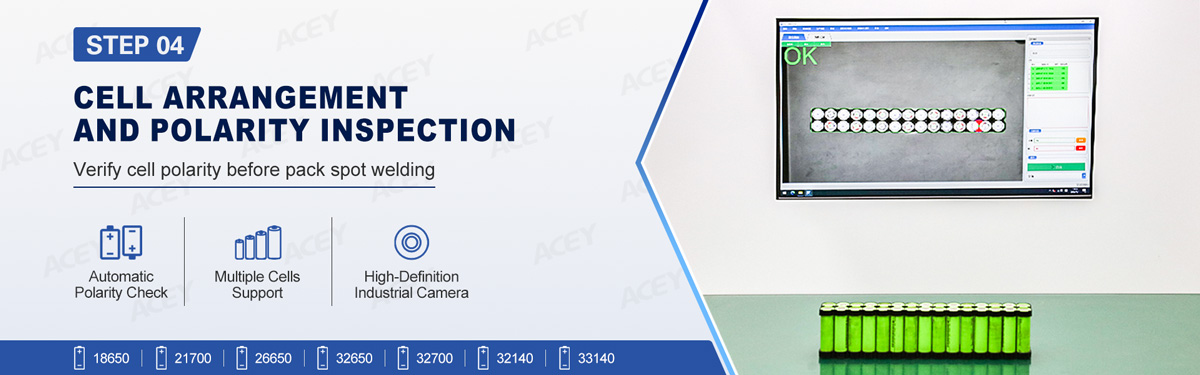
Sorted cells are placed into the required series-parallel arrangement using cell holders or dedicated fixtures.
Before welding, the positive and negative orientation of every cell should be checked.
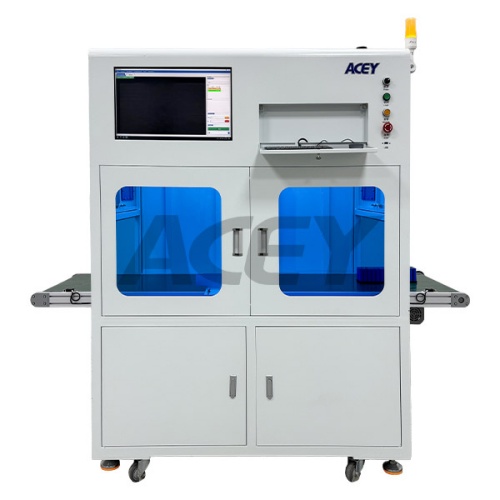
For small production runs, this may be done manually. On semi-automatic and automatic lines, a CCD polarity inspection system is more reliable because it checks the complete cell group against the preset pattern.
ACEY CCD inspection systems can be configured for cylindrical cells including:
18650 · 21700 · 26650 · 32650 · 32700 · 32140 · 33140
Any reversed or incorrectly positioned cell can be identified before the pack enters the welding station.
Recommended Equipment: CCD Tester
Step 5 — Battery Pack Spot Welding
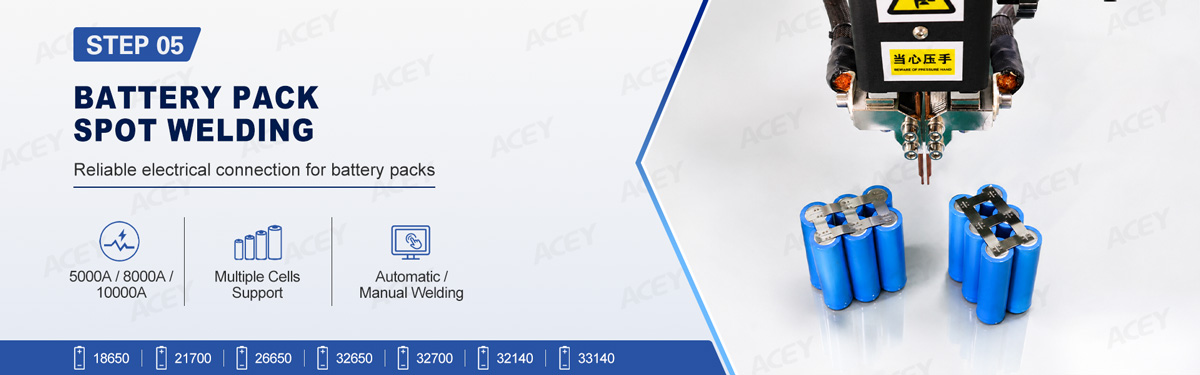
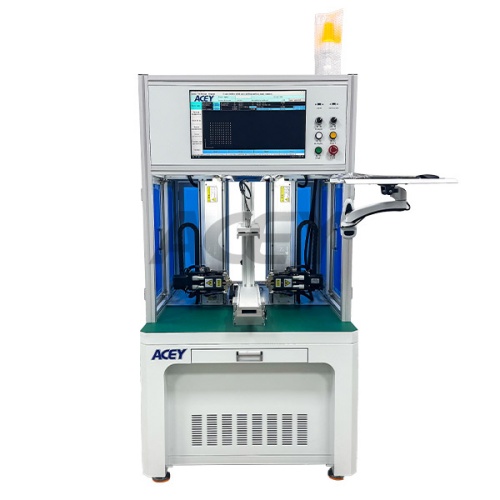
Spot welding is one of the most important operations in cylindrical battery pack assembly.
The cells are connected in series and parallel by welding nickel or nickel-plated connecting strips to the cell terminals.
The welding result is affected by more than welding current. The main process variables include:
ACEY provides 5000A, 8000A and 10000A DC inverter or transistor welding power supply configurations for cylindrical battery pack assembly.
Machine options include:
Automatic models can store welding programs for different battery pack designs and move between preset welding positions.
For production use, welding parameters should be validated with the actual cell and connecting strip. A parameter that works well on one battery pack should not automatically be copied to another design.
The inspection criteria may include weld appearance, connection strength and electrical resistance according to the manufacturer’s own process standard.
Recommended Equipment: Battery Pack Spot Welding Machine
Step 6 — BMS Testing and Installation
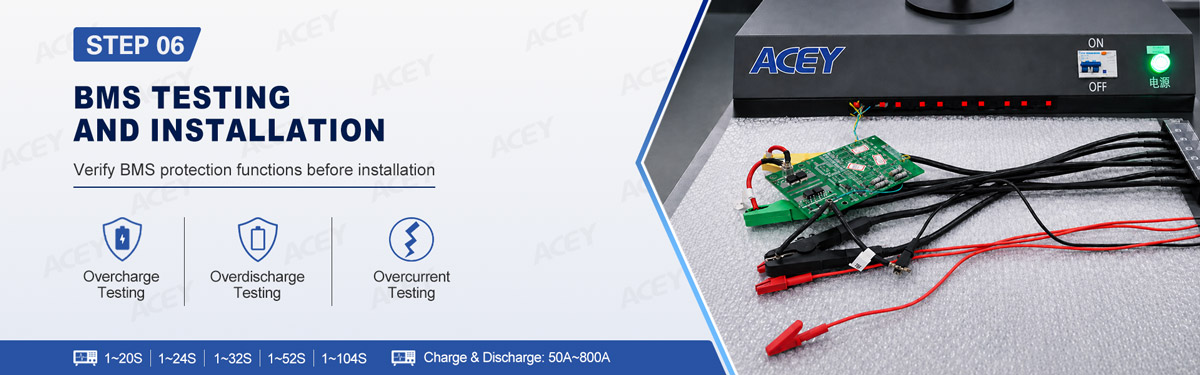
After the cell groups are electrically connected, the battery management system is installed according to the pack design.
Before installation or final integration, the BMS can be tested to verify its protection functions.
A BMS tester mainly check functions such as:
The required test range is determined by the BMS series count, voltage and current rating.
After BMS verification, assembly work includes:
This part of the process varies significantly from one battery pack to another. BMS specifications and electrical drawings are therefore important when configuring the assembly workstation or production line.
Recommended Equipment: BMS Tester
Step 7 — Finished Battery Pack Testing
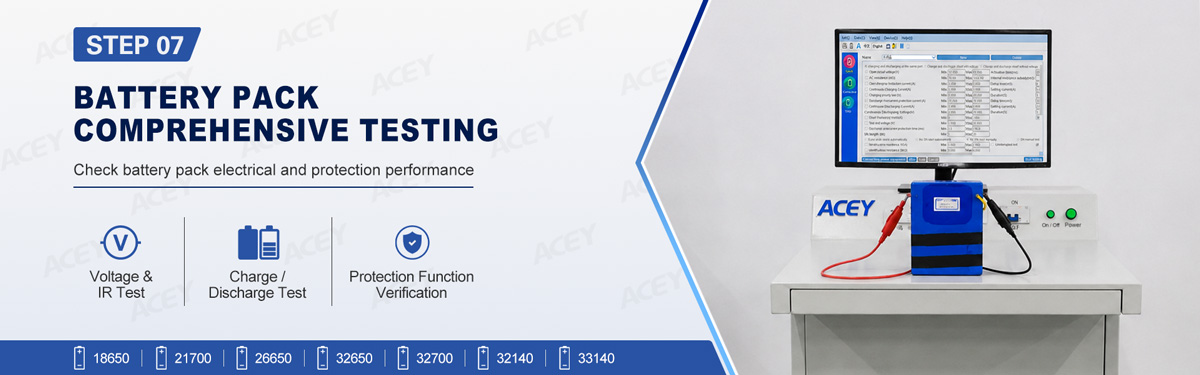
Once the BMS, wiring and electrical connections are complete, the battery pack is tested as a finished assembly.
This step checks components and connections introduced during battery pack assembly rather than the performance of an individual cell.
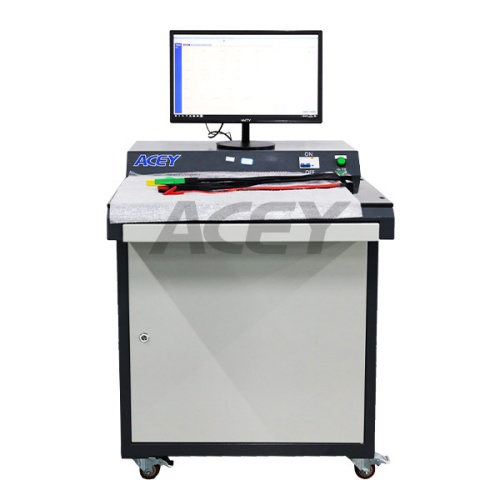
A battery comprehensive tester can be configured to test:
Upper and lower limits are set in the test program, allowing the equipment to identify qualified and unqualified packs.
Finished pack testing is particularly useful for detecting problems related to:
ACEY provides different voltage and current configurations for small and larger battery packs.
Recommended Equipment: Battery Comprehensive Tester
Step 8 — Battery Pack Packaging
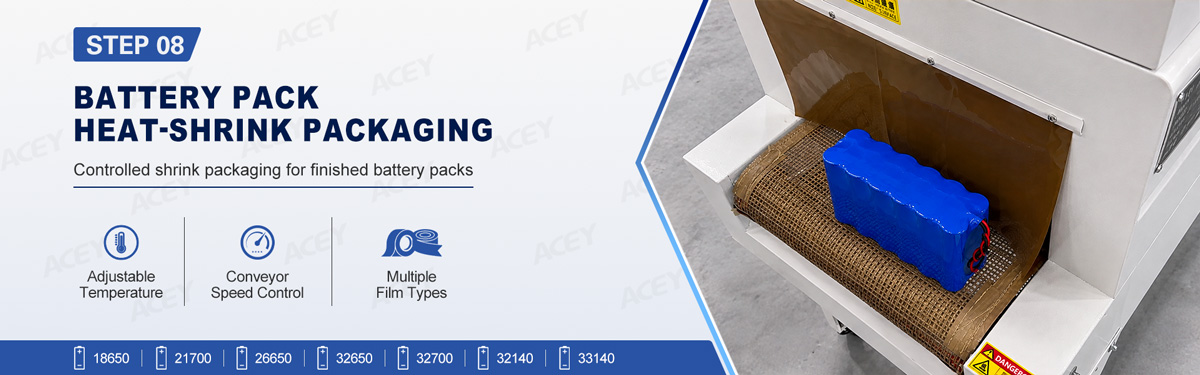
After electrical testing, the pack is prepared for final packaging.
The packaging method may include:
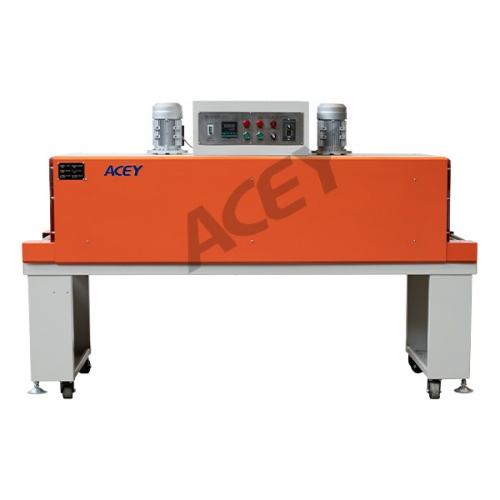
For heat-shrink packaging, the pack passes through a temperature-controlled shrink tunnel.
ACEY heat shrink machines are available with adjustable conveyor speed and temperature settings for different pack sizes and film materials.
Recommended Equipment: Automatic Heat Shrink Wrap Machine
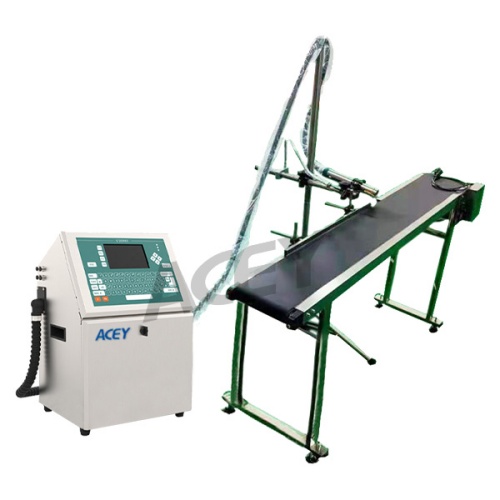
Step 9 — Coding and Traceability
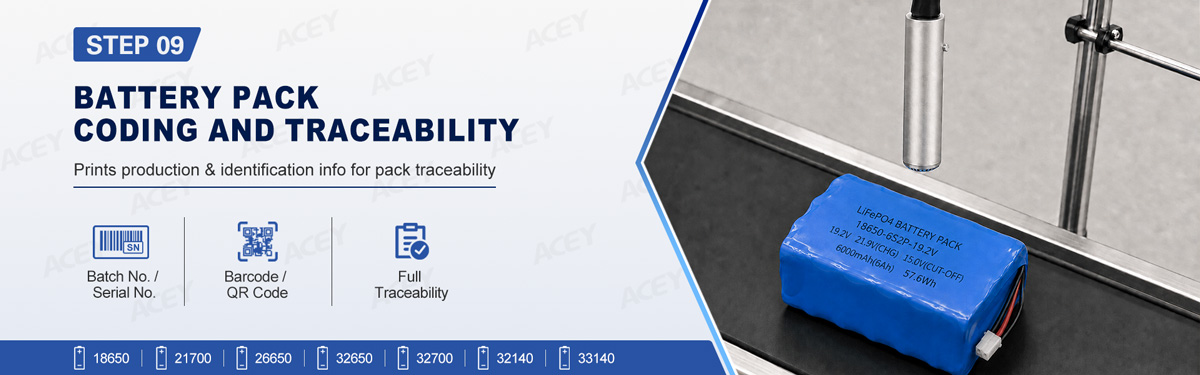
Pack identification is added before shipment or aging.
Printed information includes:
A handheld printer may be enough for small-batch production, while conveyor-based or continuous inkjet printers are more suitable for production lines.
If traceability is required, the printed code can be linked with earlier cell or pack test records.
Recommended Equipment: Battery Pack Coding Machine
Step 10 — Charge/Discharge Aging
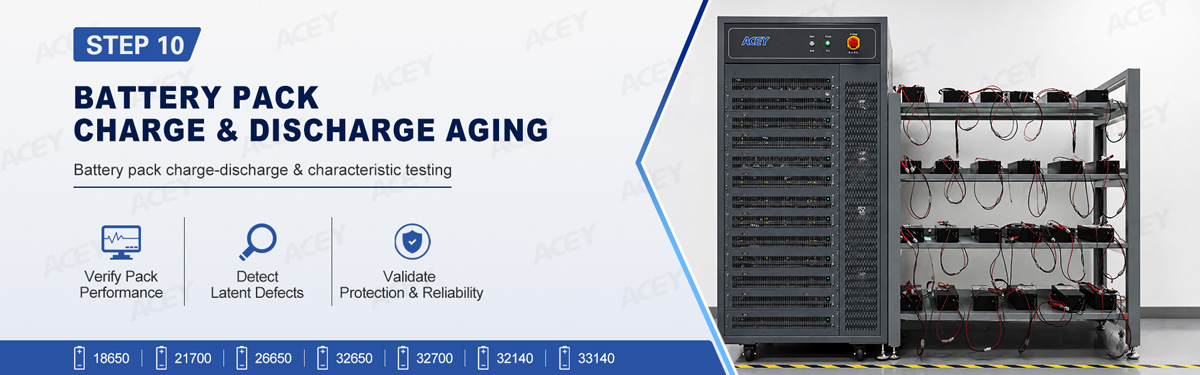
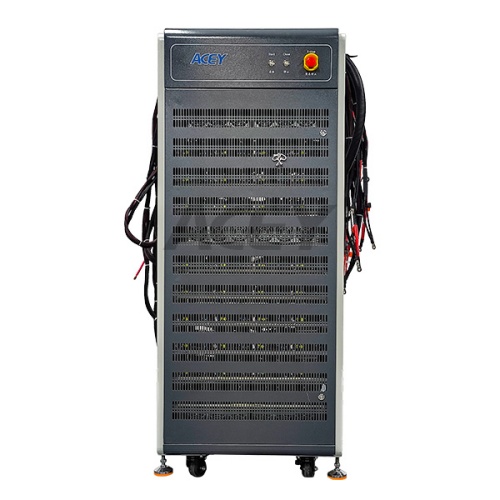
Aging is one of the final electrical verification steps.
The battery pack is charged and discharged according to a programmed test sequence. The system can record:
ACEY battery pack charge-discharge and aging systems cover a wide range of battery pack applications.
Available configurations include:
The selected tester must cover the pack’s maximum voltage and required charge/discharge current. Channel quantity is usually selected according to the planned production output and aging time.
For higher-power applications, energy-feedback systems can return part of the discharge energy to the electrical network instead of dissipating it only as heat.
Recommended Equipment: Battery Pack Aging Machine
Semi-Automatic or Fully Automatic?
The higher automation option is not always the better choice.
A semi-automatic production setup is more flexible when the manufacturer produces several battery pack models or changes fixtures frequently.
| Factor | Semi-Automatic Line | Fully Automatic Line |
| Production Volume | Small to medium | Medium to high |
| Investment | Lower | Higher |
| Changeover | More flexible | More dependent on tooling and line design |
| Labor | More manual operations | Lower labor requirement |
| Integration | Standalone or partially connected equipment | Integrated material flow |
| Traceability | Added where required | Easier to integrate across multiple processes |
Many cylindrical battery pack lines use a combination of both.
For example, cell sorting, CCD polarity inspection and automatic spot welding can be automated, while BMS installation, wiring or enclosure assembly remains manual.
This approach often gives better flexibility than trying to automate every process from the beginning.
How to Configure Cylindrical Battery Pack Assembly Equipment
The equipment should be selected from the actual battery pack design rather than only from the cell model.
Two 21700 battery packs may require completely different fixtures, welding machines and test systems if their series-parallel configuration, current requirement and mechanical structure are different.
Before equipment selection, it is useful to confirm the following information.
Cell Information
Battery Pack Design
Welding Information
BMS Information
Production Requirement
Testing Requirement
These details make it much easier to match each machine to the actual process and avoid buying equipment with either insufficient capacity or unnecessary specifications.
ACEY Cylindrical Battery Pack Assembly Solutions
ACEY supplies individual machines, semi-automatic production equipment and fully automatic assembly solutions for cylindrical lithium battery packs.
Equipment can be configured for cells including:
18650 · 21700 · 26650 · 32650 · 32700 · 32140 · 33140
Available processes cover:
For production-line projects, the configuration is developed around the customer’s battery pack, required output and test process rather than from a fixed machine list.
Planning a Cylindrical Battery Pack Project?
Please provide:
This information allows us to recommend the required machines, tooling, welding configuration and test system for the actual pack.
Discuss Your Battery Pack Assembly Project →
Frequently Asked Questions
*What machines are needed to make a cylindrical battery pack?
A typical production setup may include a cell grading machine, insulation paper sticking machine, OCV/IR sorter, CCD polarity tester, spot welder, BMS tester, battery comprehensive tester, packaging machine, coding machine and battery pack aging tester.
Small-batch production does not necessarily require all processes to be automated.
*What cylindrical cells can be used?
Common formats include 18650, 21700, 26650, 32650, 32700, 32140 and 33140.
Whether one machine can handle several cell sizes depends on its mechanical range and tooling. Fixtures, feeders and holders may need to be changed when switching cell formats.
What is the difference between capacity grading and OCV/IR sorting?
Capacity grading measures cell capacity through charge-discharge testing.
OCV/IR sorting measures open-circuit voltage and internal resistance and groups the cells according to preset ranges.
They are different steps and are often used together before battery pack assembly.
Why check cell polarity before welding?
A reversed cell can create the wrong series-parallel connection once the nickel strip is welded.
CCD inspection checks the complete cell arrangement before welding and identifies cells placed in the wrong direction.
What type of spot welder is used for cylindrical battery packs?
Resistance spot welding is commonly used for nickel and nickel-plated connecting strips.
ACEY provides 5000A, 8000A and 10000A welding power supply, including gantry, single-side automatic and double-side automatic configurations.
기계 및 용접 매개변수는 셀 단자, 스트립 재질, 스트립 두께 및 용접 패턴에 따라 선택해야 합니다.
배터와 배터의 차이점은 무엇인가요?y 팩은 종합적인 테스트와 노화 테스트를 거치나요?
하나의 생산 라인에서 여러 종류의 배터리 팩을 생산할 수 있나요?
네, 하지만 전환 과정 없이는 불가능합니다.
셀 직경, 팩 크기 또는 용접 패턴이 변경되면 홀더, 고정 장치, 공급 장치 또는 용접 프로그램도 변경해야 합니다.
반자동 생산 라인은 여러 배터리 팩 모델을 생산하는 고객에게 더 큰 유연성을 제공합니다.
ACEY는 생산 라인을 추천하기 전에 어떤 정보가 필요합니까?
가장 유용한 정보는 다음과 같습니다.
이러한 세부 정보를 활용하면 일반적인 생산 라인 구성을 사용하는 대신 실제 배터리 팩에 맞춰 장비와 공구를 선택할 수 있습니다.
Rm703, No.223, Qishan North Road, Huli District, Xiamen, Fujian, China
이메일 : allen@xmacey.com
Tel : +8618950009155
Whatsapp : +8618950009155