
XIAMEN ACEY NEW ENERGY TECHNOLOGY CO., LTD.

How ACEY Helped a European Customer Expand 32140 and 26650 Battery Sorting with MES Integration
November 19 , 2026
A European battery pack company selected ACEY to expand sorting for 32140 and 26650 cylindrical cells and connect the equipment to its manufacturing execution system (MES). The project combined dedicated sorting machines, barcode identification and remote engineering support through to production commissioning.
In customer-reported on-site operation, the ACEY-AS10SP sorted approximately 3,200 units of 32140 cells per hour, while the ACEY-AS11S sorted approximately 4,000 units of 26650 cells per hour. The customer also reported a 30% improvement in sorting efficiency compared with its previous equipment.
Project Overview
| Item | Project details |
| Customer | European battery pack company |
| Project purpose | Sorting capacity expansion and cell data traceability |
| Actual cell formats | 32140 and 26650 cylindrical cells |
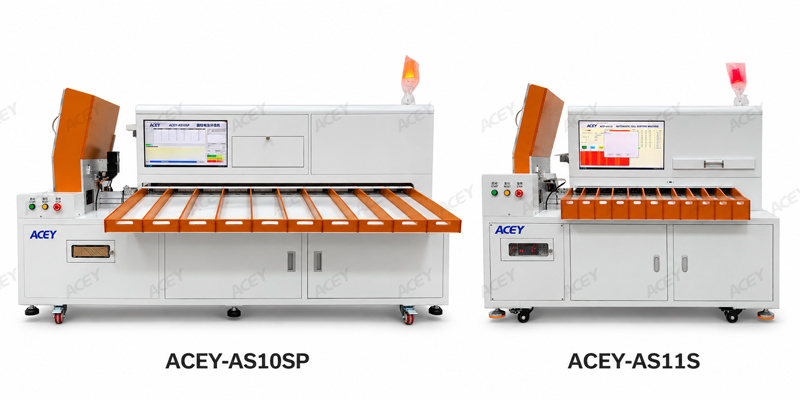
| Selected sorters | ACEY-AS10SP 10-channel and ACEY-AS11S 11-channel |
| Testing and identification | OCV, internal resistance, sorting grade and cell SN code |
| MES connection | OPC UA; commissioned with real cells and moved to the production environment |
The Customer Needed Sorting Capacity and Traceable Records
The customer already used a sorter for 26650 cells, but the older equipment had no barcode scanner or MES connection. Operators recorded data manually, making the process cumbersome. The expansion required sorting for 32140 cells as well as a better way to identify cells and manage their test records.
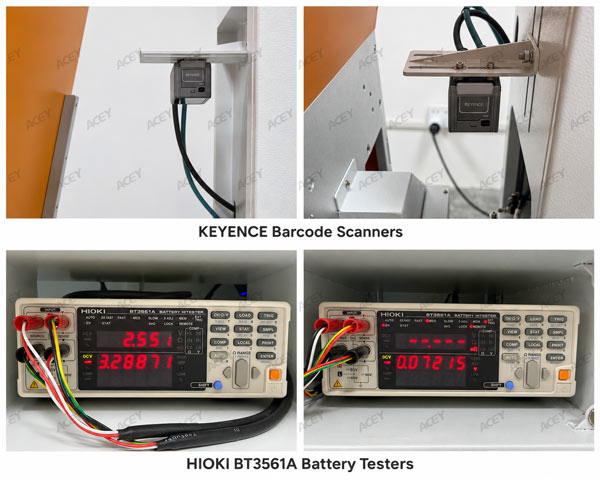
The customer initially asked whether one machine could handle both formats and specified HIOKI battery testing and a KEYENCE scanner. Its engineering team also requested the MES interface requirements and communication details so that integration preparations could begin before the equipment arrived.
Separate Sorting Machines for 32140 and 26650 Cells
ACEY reviewed the cell dimensions and terminal arrangement. The substantial length difference between the two formats affected feeding, positioning and test contact arrangements, so ACEY recommended separate sorting configurations for this project.
The ACEY-AS10SP 10-channel battery sorting machine was selected for 32140 cells. This model also supports 33140 cylindrical cells. For the customer's 26650 cells, ACEY supplied the ACEY-AS11S 11-channel battery sorter, which supports 18650, 21700, 26650, 32650 and 32700 formats.
ACEY offered a HIOKI BT3561A testing configuration with barcode scanning. The sorting process measures open-circuit voltage (OCV) and internal resistance, assigns a sorting grade and associates the results with the cell's serial number (SN) for transfer to MES.
MES Integration from Simulation to Production
The integration work took place in two stages: preliminary interface testing before shipment, by full commissioning with the installed machines and real cells at the customer's factory.
Interface Verification Before Shipment
After the customer's engineers provided the interface information, ACEY used a simulator to connect to the customer's MES test environment. This allowed both teams to check communication feasibility and identify protocol or data-field mismatches before delivery.
This preliminary test prepared the interface for the next stage. Verification of barcode reading and actual cell test data took place after the sorting machines reached the customer's factory.
The teams then ran barcode-scanning tests with both 32140 and 26650 cylindrical cells. Each sorter read the cell SN code, collected the measured OCV, internal resistance and sorting grade, and pushed the records to MES in real time.
Both teams checked uploaded records individually for completeness and accuracy. They verified data messages for accepted and rejected (NG) cells in each format and checked for missing messages, duplicate uploads and other transfer errors.
Moving to the Production MES Environment
After several small-batch trial runs confirmed stable operation, the connection was switched from the MES test environment to the production environment. Cell identification, electrical test results and sorting grades could then be managed together in the customer's MES, establishing traceable records from barcode scanning through sorting.
Customer Reported Results
After receiving and using the machines, the customer reported the following sorting rates for its two cell formats.
| Sorting machine | Customer cell format | Reported on-site sorting rate |
| ACEY-AS10SP | 32140 | Approximately 3,200 cells/hour |
| ACEY-AS11S | 26650 | Approximately 4,000 cells/hour |
The customer reported sorting efficiency approximately 30% higher than with its previous equipment. It also highlighted direct transfer of cell information to MES, less manual data recording and easier traceability and cell grouping. These results describe this customer's operation with the specified cells.
"Our old sorter had no barcode scanner or MES connection, so we had to record data manually. With the new equipment, cell information goes directly to MES, helping us trace cells and reduce grouping mistakes. The equipment is running well, and sorting efficiency is about 30% higher than with our previous equipment. We look forward to working with ACEY again."
——European battery pack project manager.
The customer also placed follow-up orders for an additional large-cell sorter and an 11-channel sorter for 26650 cells, extending the project beyond the initial large-cell sorting requirement.
Discuss Your Cell Sorting and MES Requirements
For 32140 or 33140 cells, explore the ACEY-AS10S 10-channel battery sorting machine. For 18650, 21700, 26650, 32650 or 32700 cells, see the ACEY-AS11S cylindrical battery sorter with barcode scanning.
Send ACEY your cell drawings, target throughput, sorting criteria and barcode details. If MES integration is required, include your interface and data transfer requirements so our engineers can review the connection before delivery and support commissioning at your factory. Contact our team to discuss your project.
Rm703, No.223, Qishan North Road, Huli District, Xiamen, Fujian, China
이메일 : allen@xmacey.com
Tel : +8618950009155
Whatsapp : +8618950009155